Mar 28, 2026
12 min read
If you are anything like most people trying to stay informed in 2026, you probably do both. You have a handful of podcasts you rotate through on your commute. You have newsletters you subscribed to with good intentions, some of which you actually read. And somewhere in the back of your mind, you have a vague sense that you should be doing more of one or less of the other, but you have never quite stopped to think it through.
That is what this post is for.
The newsletters versus podcasts debate tends to get framed as a competition. Which one is better? Which one should you prioritise? Which one is winning? But that framing misses the point entirely. Newsletters and podcasts are not rivals. They are different tools designed for different cognitive jobs. The question worth asking is not which one makes you smarter in the abstract. It is which one makes you smarter at what, and how to use both in a way that actually compounds over time.
The honest answer is that both formats have genuine strengths. Podcasts are one of the most powerful inventions for learning while doing something else. The ability to absorb a long-form conversation during a commute or a run is genuinely remarkable, and the best podcast hosts ask questions that no writer would think to ask. Newsletters, on the other hand, offer something different: focused reading, precise argument, information you can re-read, reference, and return to. They reward attention in a way that audio simply cannot.
Understanding the difference changes how you use both. Instead of drifting between the two without intention, you start deploying each one for what it is actually good at. Your podcast listening becomes more deliberate. Your newsletter reading becomes more consistent. And the combination starts doing something neither could manage alone.
That is where Bilig comes in. Bilig is a newsletter reading platform built to give your newsletters a focused home, separate from inbox noise and the pull of everything else. If you want a system for reading more consistently, How to Turn Newsletters into a Source of Daily Growth (The Bilig Way) is a good starting point. If the problem is less about format and more about distraction, Beat Brain Rot: 10 Ways to Replace Doomscrolling and Reclaim Your Attention addresses that directly.
For related reading, our guide on how to build a quality newsletter stack explains how to curate your subscriptions with intention. And if you are still fighting the pull of social feeds, Ditch Doomscrolling: How Newsletters Beat Social Media for Your Brain makes the case for a better alternative.
Here is an honest look at how newsletters and podcasts actually compare, and how to get the most out of both.
Before comparing the two formats on any practical dimension, it helps to understand what each one is actually doing when you engage with it.
Podcasts are primarily an auditory and passive format.
You absorb them in parallel with something else: driving, walking, cooking, exercising. That parallel processing is exactly what makes them so convenient, and it is also what limits them.
Your brain is dividing its attention. The content competes with road signs, other pedestrians, and the general background noise of being in the world. You are present enough to follow along, but rarely present enough to deeply encode what you are hearing.
This is not a flaw. It is a feature. Podcasts were not designed for deep retention. They were designed for engagement, for long-form conversation, for the kind of exploratory thinking that happens when two smart people talk something through without a script.
Newsletters work differently. Reading is a format that naturally accommodates different levels of engagement. Some people read every word. Others skim headlines and drop into the sections that catch their attention. Both are valid, and a well-written newsletter is designed to reward either approach.
But for people who genuinely enjoy reading, or who find it easier to follow an argument in written form than to track it through audio, newsletters offer something podcasts simply cannot replicate: the ability to go at your own pace, pause when something lands, re-read a line that deserves a second pass, and engage with ideas on your own terms rather than at the speed of someone else's voice.
Neither format is superior. They are engaging different cognitive systems, at different moments in your day, for different purposes. Understanding that is the foundation for using both well.
| Dimension | Newsletters | Podcasts |
|---|---|---|
| Retention & Recall | Proper reading improves encoding and memory | Usually listened while multitasking, leading to lower retention |
| Convenience & Multitasking | Requires focused time and attention | Fits around other activities naturally |
| Depth & Nuance | Written format allows precise argument and data | Longer podcasts are nuanced but conversational format can sometimes sacrifice precision in arguments and facts |
| Discovery & Breadth | Strong – allows for discovering new topics and ideas | Strong – allows for discovering new topics and ideas |
| Consistency & Habit | Asynchronous, read at your pace, no time pressure | Asynchronous, listen at your pace, no time pressure |
Retention and recall is where newsletters have their clearest structural advantage. Research consistently shows that reading produces better long-term retention than listening, particularly for factual and conceptual information. When you read something, you are constructing a mental model of it. When you listen, you are following someone else's model in real time. Both create understanding, but the first tends to stick longer.
Convenience and multitasking is the category podcasts were built for, and they win it comfortably. The ability to absorb a ninety-minute conversation while doing something you would have to do anyway is a genuine superpower. Newsletters cannot compete here. They require you to sit down, focus, and read. That is a cost that podcasts simply do not impose.
Depth and nuance edges toward newsletters, though the gap is narrower than it first appears. Written formats allow for precise argument, cited data, and structured reasoning that is hard to sustain in a conversational audio format. A newsletter writer can construct and refine a point across multiple drafts. A podcast host has one pass in real time. That said, the best podcast conversations go places that no article ever would, because the spontaneous nature of dialogue generates ideas that a solo writer would not produce alone.
Discovery and breadth is the most even category. Both formats are excellent for finding new ideas, new thinkers, and new perspectives. Newsletters often surface things with a link to go deeper immediately, which creates a natural path from discovery to learning. Podcasts introduce you to people and ideas in a more immersive way, which can create a stronger initial impression and make you more likely to follow up.
Consistency and habit is even across both mediums as well. Both newsletters and podcasts can be enjoyed at your own pace, spread across a day or even a week. While a certain level of commitment and discipline is required for both to maintain consistency, neither asks for a significant commitment and allows flexibility with your time.
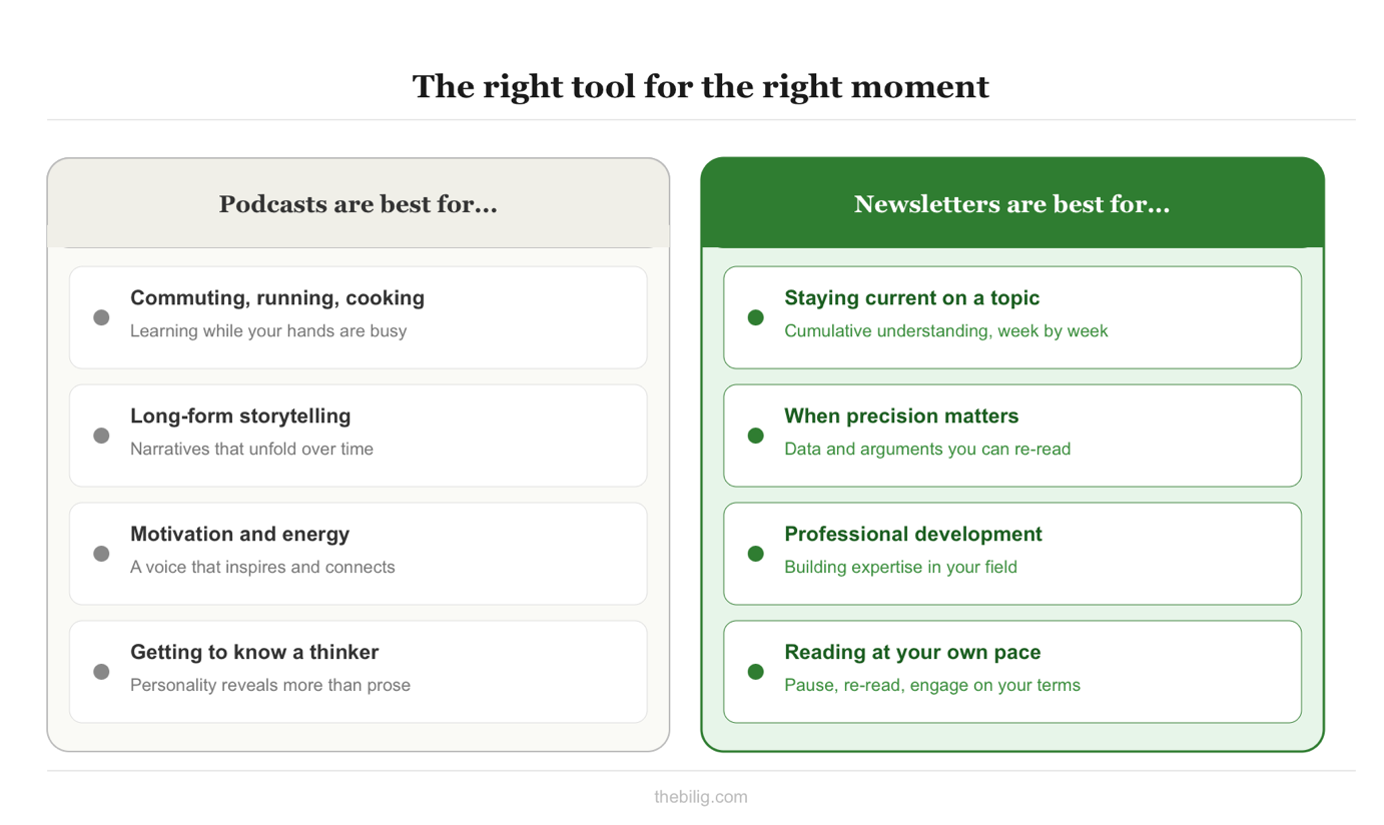
Beyond the head-to-head comparison, each format has a natural territory where it outperforms the other. Knowing that territory helps you deploy each one intentionally rather than defaulting to whichever one is most convenient in a given moment.
Podcasts are at their best for long-form storytelling and narrative. When a topic requires you to understand a journey, a relationship, or a sequence of events that unfolds over time, audio storytelling is genuinely hard to beat.
They are also the superior format for motivation and energy. Hearing a person's voice, their enthusiasm, their pauses and emphasis, creates an emotional connection that the written word rarely matches. For commuting, exercising, or any activity that benefits from a companion in your ear, podcasts are simply the right tool.
Podcasts also excel at introducing you to a thinker as a full person rather than as an author. A long conversation reveals personality, reasoning style, and intellectual honesty in ways that even the best written work does not. If you want to decide whether someone is worth following, listening to them think out loud for an hour is often more revealing than reading their most polished essay.
Newsletters are at their best when you want to stay current on a topic over time. The recurring nature of a good newsletter means that you are not just reading individual pieces of content but building a cumulative understanding of a subject, an industry, or a set of ideas week by week.
That compounding effect is something podcasts rarely replicate, because episodes tend to be more standalone and less connected.
Newsletters are also the right format when precision matters. If you need to understand a specific development, a data point, a policy change, or an argument in detail, reading it is almost always better than hearing it. You can slow down, re-read, and actually absorb the specifics. For professional development, staying current in your field, and building genuine expertise, newsletters have a structural edge that podcasts cannot close.
The most effective approach is not to choose between newsletters and podcasts but to think about how they sequence and reinforce each other.
Used deliberately, the two formats can do something neither manages alone: they can take you from a first encounter with an idea all the way to genuine understanding.
One natural pattern is to use newsletters as your scanning layer. You read broadly, follow threads, and flag the topics and thinkers that keep coming up. When something catches your attention, you go deeper through podcasts, seeking out long-form conversations with the people behind the ideas. The newsletter gives you the map. The podcast gives you the terrain.
The reverse works equally well. You hear something interesting in a podcast conversation, a reference you want to follow up, a thinker whose argument you want to understand more carefully. You look for their newsletter. Suddenly the passive listening has generated active reading, and the idea that was floating has somewhere to land.
The key in both cases is intentionality. Most people do not have a system. They subscribe to newsletters they forget to read and add podcasts to a queue that never clears. The goal is not to consume more. It is to build a reading and listening practice where the two formats are working together rather than competing for the same fragmented attention.
For the newsletter side of that equation, Bilig is designed to make the habit sustainable. Rather than newsletters getting buried in an inbox alongside everything else, Bilig gives them a dedicated feed built for focused reading. You can explore Bilig's features or start building your newsletter stack on the newsletter directory.
The smartest question was never newsletters versus podcasts. It was always how to use each one well. Podcasts make the time between places more valuable. Newsletters make the time you set aside for learning more productive. Together, used with intention, they are two of the most powerful tools available for anyone who takes their own development seriously.