Feb 9, 2026
12 min read
Information overload is real. Most people try to stay informed by jumping between news sites, social media, and endless tabs, and it usually ends in doomscrolling and scattered attention. The result is brain rot and a growing dissatisfaction with the way information is consumed.
This is why building a quality newsletter stack matters. A quality newsletter stack is the difference between reading intentionally and consuming randomly. Instead of letting information arrive in a chaotic stream, you create a carefully picked list of newsletters that cover the subjects you care about, at a pace you can maintain. The outcome is simple and practical: you stay informed without living on news sites, you keep learning without turning it into homework, and you reduce the "information overload" that comes from trying to follow everything everywhere.
But none of that works if the reading experience is messy. If newsletters live inside a crowded email inbox, they compete with work, logistics, promotions, and distractions. That's where Bilig helps. Bilig is a newsletter reading app that gives newsletters their own home, so you can actually read what you subscribe to, organize your stack by topic, and keep your reading habit consistent.
If you want a practical system for turning newsletters into a daily habit, the best starting point is How to Turn Newsletters into a Source of Daily Growth (The Bilig Way). If your bigger struggle is attention and information overload, Beat Brain Rot: 10 Ways to Replace Doomscrolling and Reclaim Your Attention will help. And if you're building topic-specific stacks, our curated lists give you a strong foundation, including our roundup of AI newsletters and our list of productivity newsletters.
In this post, we'll define what a quality newsletter stack is, why it matters, and how to build one that keeps you informed and learning without drowning you in content.
A quality newsletter stack is a deliberate set of newsletters you trust and actually read. It's not a long list of subscriptions. It's a hand-picked, focused collection of information sources that consistently deliver value. The goal is to build your own reading ecosystem, one that helps you stay on top of developments, learn across topics, and develop better judgment over time.
Quality comes from a few simple principles. The newsletter should have a clear focus, so you know what it covers and what it ignores. It should have a consistent editorial standard, so the writing and curation feel reliable. It should respect your time, either by summarizing the important things well or by going deep with a clear point. Most importantly, it should remain useful after the first few reads. If it's good, you keep coming back because it makes you smarter, faster, or more informed.
A strong stack also has balance. Most readers benefit from having different "roles" inside the stack. You might have one newsletter that gives quick awareness, a couple that go deeper with analysis, and one or two that expand your perspective outside your comfort zone. This is how newsletters stop feeling like an endless stream and start feeling like a system. You're not trying to read everything. You're building a structure you can maintain.
When your stack is built intentionally, it becomes the simplest cure for information overload: fewer sources, better inputs, and a reading habit you can actually sustain.
A quality newsletter stack gives you a trusted information system you can rely on. Instead of bouncing between random sources and hoping you did not miss something important, you create your own reading ecosystem. Over time, this becomes a personal advantage. You know where to go for clear summaries, where to go for thoughtful analysis, and which writers consistently help you understand what is happening.
A strong stack also improves the quality of what you consume. Most information overload is not caused by too much content. It is caused by low-quality content taking up too much time. When you subscribe intentionally, you stop wasting attention on repetitive takes, weak summaries, and content designed to trigger emotion instead of understanding. You spend your reading time on writing that adds context, filters noise, and helps you build a clearer picture.
Finally, a quality newsletter stack is a practical alternative to doomscrolling and other unhealthy information habits. Social media and fast feeds reward speed, outrage, and constant checking. Even when you learn something, the experience is usually scattered and draining. Newsletters are the opposite. They are finite, structured, and often calmer in tone. They make you a more intentional reader because they reduce randomness. You choose what enters your information diet, you choose when to read it, and you decide what is worth keeping.
The easiest way to build a stack is to give each newsletter a role. If you subscribe without roles, everything competes for the same attention and you fall behind. If you assign roles, your stack becomes predictable and manageable.
Start with one or two daily briefs. This is your "awareness layer." It should be short, fast to scan, and focused on helping you stay current without spending all day on news sites. A daily brief is not where you get deep understanding. It is where you get a clear picture of what happened and what matters today. Up to two per day is enough. Three is usually too much unless they all cover completely different areas.
Then add the weekly deep reads. This is your "understanding layer." These newsletters should go deeper, explain why things are happening, and connect ideas across time. This is where you learn the bigger picture: how a topic is evolving, what is changing beneath the surface, and what to pay attention to next. Weekly deep reads are the backbone of a quality stack because they compound. After a month or two, you start seeing themes repeat and you build real knowledge rather than just staying updated.
Finally, add one wildcard. This is where you protect curiosity and avoid narrowing your inputs. The wildcard can be culture, history, science, design, psychology, writing, or anything that makes you think differently. It matters because a stack that is purely "useful" often becomes narrow and predictable. A wildcard keeps reading enjoyable and expands your perspective, which usually improves your thinking in the areas you care about most.
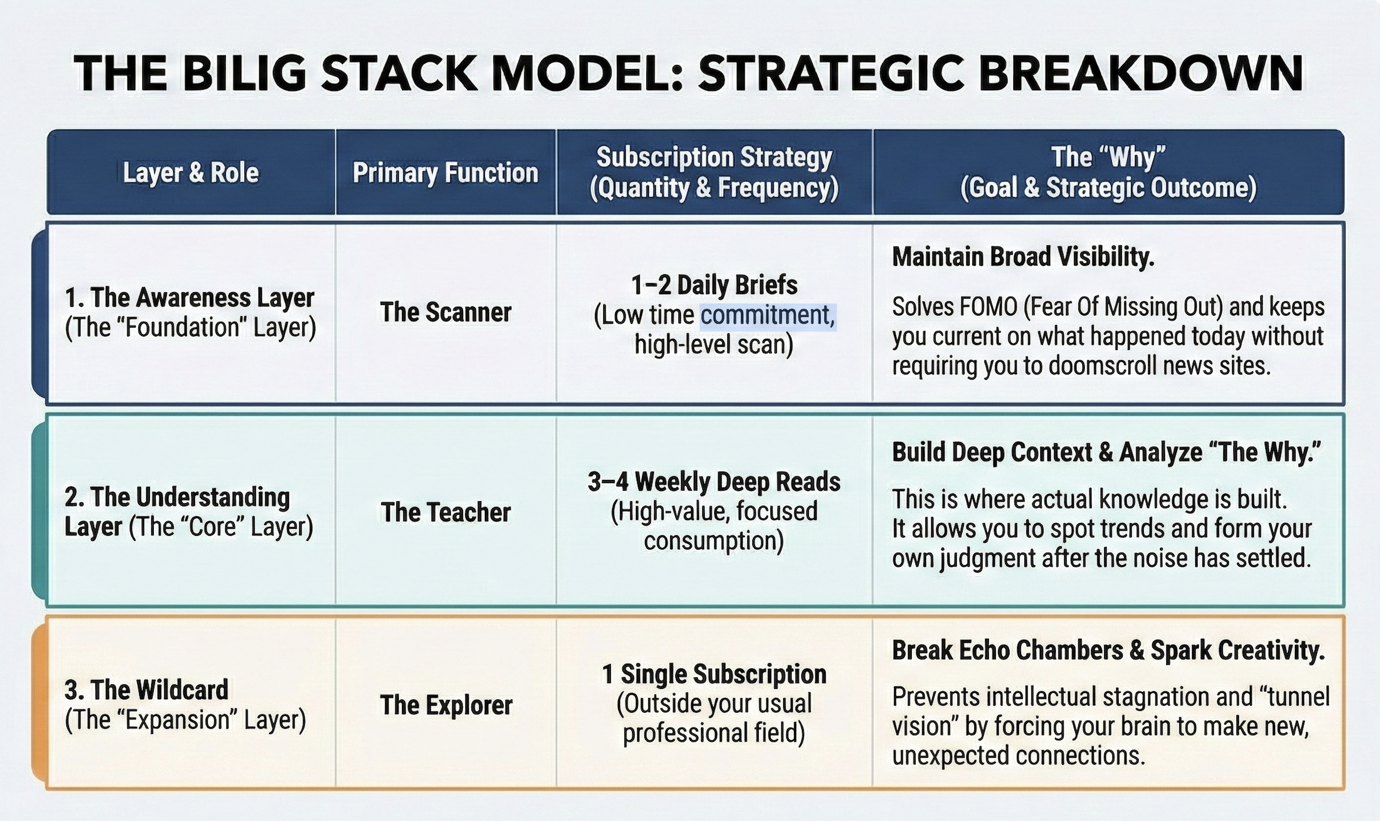
If you want to keep this simple, treat it as a baseline: two daily briefs, three to four weekly deep reads, one wildcard. That is a stack you can maintain without feeling like newsletters are a second job. Once that feels stable, you can add one more lane, such as a topic-specific newsletter for your work or a field you want to learn faster. The principle stays the same: every newsletter must have a role, and every newsletter must earn its place.
Start with the subjects you genuinely care about, not what you think you "should" read. A quality stack works when it matches your life. The simplest way is to choose a small set of topic lanes that cover both staying informed and personal growth. For example: current affairs, tech, markets, health, and culture. If you only read one lane, you risk getting narrow. If you read too many, you dilute attention and fall behind. A practical sweet spot is five to seven lanes, with one or two "core" topics you read more heavily and a couple of lighter lanes that keep your inputs varied.
Also, decide what you are optimizing for. Do you want to stay informed, build professional edge, improve decision-making, or expand curiosity? Those goals lead to different newsletter choices. The stack becomes much easier to build when each topic has a purpose.
Discovery is how your stack stays fresh, but it needs a simple rule, or it becomes another source of noise. Treat new subscriptions as trials. Add one new newsletter every now and then, read two to three issues, and then decide: keep, pause, or remove. This is better than subscribing to ten at once and never building a real relationship with any of them.
When you discover, do it intentionally. Look for writers with clear expertise, strong editorial judgment, and a consistent track record. Pay attention to whether a newsletter adds something you cannot easily get elsewhere. If it repeats what you already see in mainstream coverage, it is not earning a place.
If your stack is only made of sources you agree with, it will feel comfortable but it will not sharpen you. This matters most in current affairs, politics, economics, and culture. Reading across the spectrum does not mean consuming extreme takes. It means including at least one or two serious sources that challenge your default viewpoint, while still being credible and well-argued.
A practical approach is to have one or two newsletters that align with how you naturally see the world, and one that often disagrees but is thoughtful. Over time, this reduces blind spots. It also makes you more resistant to manipulation because you can recognize framing tricks and missing context faster.
Because we're a newsletter reading platform, we're not here to tell you to read fewer newsletters for the sake of it. The goal is to read more, but without chaos. Your baseline structure is a good starting point: two daily briefs, three to four weekly deep reads, and one wildcard. That's six to seven newsletters that are actively doing work for you.
From there, you can expand in a controlled way by adding one lane at a time. A realistic "serious reader" stack is often 10 to 15 newsletters, but only if the roles stay clear. The moment it starts feeling like a backlog, the stack has outgrown your time. Stack size is not about the number you subscribe to. It's about the number you can actually read consistently.
The biggest mistake people make is adding newsletters and never removing them. Over time, the stack becomes bloated and you stop reading altogether. A quality stack stays quality because it gets pruned.
Use a simple review rule. If you haven't opened a newsletter in four weeks, it goes on probation. If you ignore the next two issues, remove it or pause it. Also prune when newsletters change. Sometimes the writer's focus shifts, the quality drops, or the content becomes repetitive. You are not making a moral judgment. You are protecting your attention.
A monthly quick clean-up is enough. The goal is to keep your stack tight, current, and worth reading.
A newsletter stack should serve you, not pressure you. The easiest way to avoid overwhelm is to stop treating newsletters like a to-do list. You do not need to read everything the day it arrives. A daily brief is timely, but weekly deep reads are designed to be read when you have space. If you miss an issue, skip it. The habit matters more than completion.
This is also why it helps to separate your reading by energy level. Use daily briefs for low-energy moments and deep reads for your best attention windows.
Saving everything creates a second inbox. Instead, keep a short queue of three to five items. When something is truly worth reading later, save it into the queue. When the queue is full, you don't add more. You finish one item, then add another. This simple limit is how you stay intentional and avoid the "endless backlog" feeling.
Reading becomes far more valuable when you capture the best parts. This does not need to be complicated. Highlight the lines that actually change how you think, and write one sentence about the main takeaway. That's it. Over time, this turns newsletters into a personal library of ideas. You can revisit insights when you need them, and you can build your own thinking faster because you're not constantly starting from zero.
Capture also helps you remember. A lot of people read good writing and forget it within days. A highlight and one sentence note prevents that.
A quality newsletter stack solves a modern problem: too much content, not enough clarity. When you build your stack deliberately, you get the benefits of reading more without feeling overwhelmed. You stay informed through daily briefs, build real understanding through weekly deep reads, and keep your curiosity alive through a wildcard lane. Then you maintain quality by pruning regularly and making the system sustainable with a small queue and simple capture.
This is exactly the experience Bilig is built for. Bilig is a newsletter reading app that helps you build and manage your stack in one place, away from inbox clutter and away from the feed. It's designed for people who want newsletters to be a learning system, not a messy stream. If you want to turn newsletters into a habit you can actually sustain, Bilig gives you a clean reading home, discovery across topics, and the tools to highlight, save, and keep your best ideas.