Apr 2, 2026
8 min read
If your newsletters are piling up, you're not alone.
Most people subscribe with good intentions. You want to stay on top of AI, markets, tech, or whatever you care about. But after a few weeks, your inbox turns into a graveyard of unread emails. You stop opening them, you feel slightly behind, and eventually you ignore them altogether.
At that point, newsletters go from being useful to just another source of stress.
Here's the thing: the problem isn't how many newsletters you subscribe to. It's how you're managing them.
Email inboxes were never designed for reading. They were built for communication, which means everything inside them competes for your attention at the same level. A thoughtful essay from a great writer sits next to a calendar reminder, a receipt, or a random notification.
Even if the content is high quality, the environment works against you. You open your inbox to read something, get pulled into something else, and by the time you come back, you've lost context. Over time, this creates just enough friction to break the habit.
That's why newsletters feel harder to keep up with than they should.
When people try to fix this, they usually go in one of two directions.
The first is to automate everything. They unsubscribe from most newsletters, rely on summaries, or try to compress everything into quick takeaways. It feels efficient, but it comes at a cost. You get the surface-level information, but rarely the depth. You're updated, but not necessarily better informed.
The second approach is the opposite. People keep all their subscriptions and tell themselves they'll catch up later. That backlog builds quietly in the background, turning reading into something that feels like a task rather than something valuable. Eventually, it becomes overwhelming enough that they disengage entirely.
Neither approach really solves the problem.
Managing newsletters well is less about reading more or less, and more about removing friction and creating a system you can stick to.
The biggest shift is separating newsletters from your inbox. As long as they live alongside work emails and notifications, they will always feel secondary and easy to ignore. Moving them into a dedicated reading space changes the dynamic completely. When you sit down to read, you're not multitasking. You're doing one thing.
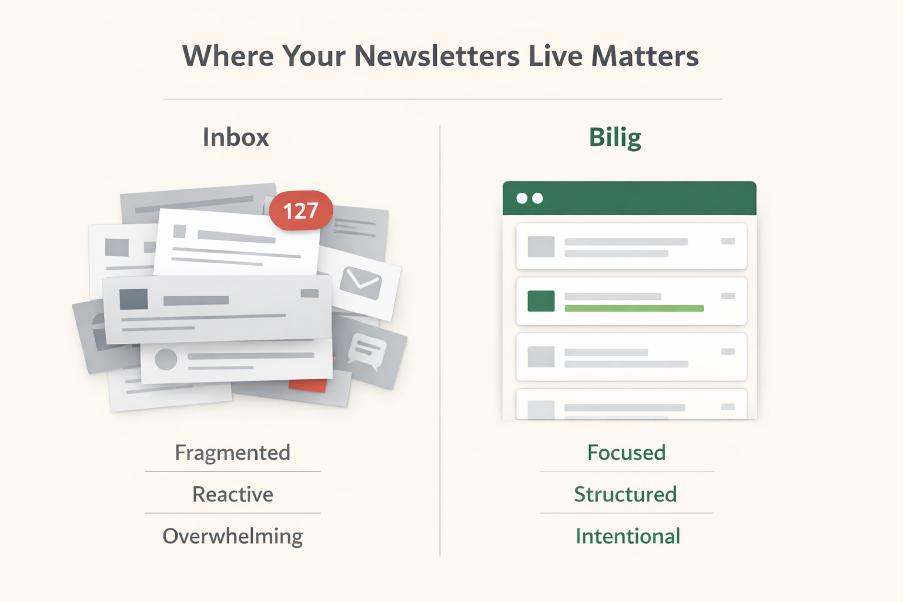
This can be as simple as using a separate email or folder, but it becomes much more effective with a dedicated newsletter reading platform like Bilig, where everything is organized and designed specifically for reading.
The second shift is being more intentional about what you subscribe to. Most people don't have a consumption problem, they have a selection problem. If you're consistently skipping a newsletter, it's a signal. Keeping only what you genuinely want to read makes the entire system lighter and easier to maintain.
The third shift is changing when and how you read. Instead of reacting to newsletters as they arrive, it helps to treat reading as a focused activity. Setting aside a bit of time, even if it's just a few minutes, allows you to go through content with context and attention, rather than in fragmented bursts.
Finally, engaging with what you read makes a big difference. Highlighting key ideas or jotting down a quick note turns reading into something active. Over time, this is what actually leads to better understanding and retention.
What makes this approach work isn't discipline. It's simplicity.
When newsletters are in the right place, when you're reading them intentionally, and when you're only following what actually matters to you, the entire experience becomes lighter. There's less pressure to keep up and more incentive to actually engage.
At that point, reading stops feeling like something you should do and starts feeling like something you want to do again.
There's no shortage of content today. If anything, there's too much of it.
The challenge isn't access. It's structure.
When everything comes through the same channel, it all feels equally important, even when it isn't. Creating a system where newsletters have their own space gives you back control over how you consume information.
That's ultimately what tools like Bilig are trying to solve. Not by reducing the amount you read, but by improving the way you read it.
Because the goal isn't to consume more content.
It's to understand more of what actually matters.
You can absolutely build a system like this manually.
You can create folders, use a separate email, or try to stay disciplined about when and how you read. But over time, most people run into the same issue: the setup starts to break down as volume increases.
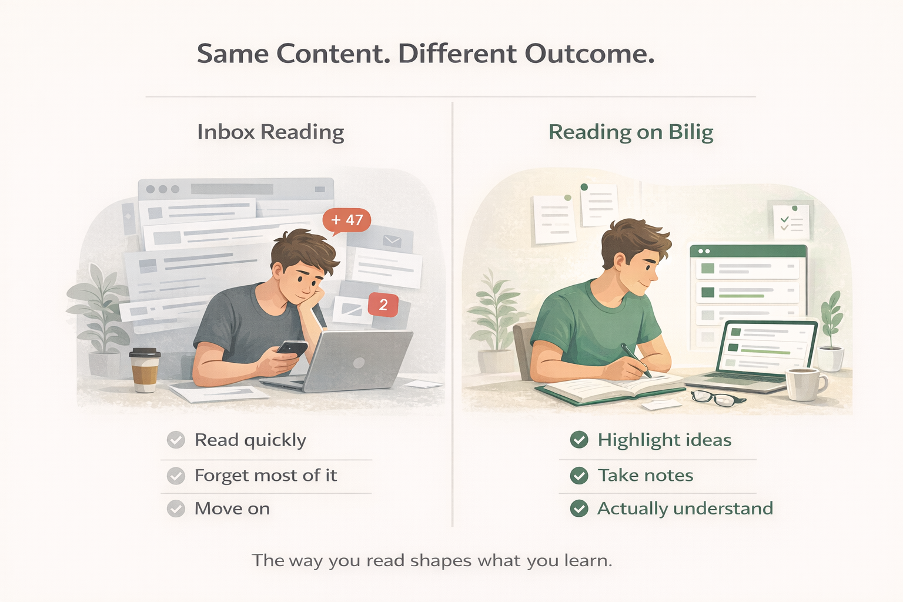
This is where using a dedicated newsletter reader like Bilig starts to make a lot more sense.
Instead of adapting your behavior to fit the inbox, you're using a tool that's designed specifically for how newsletters are meant to be consumed. Everything lives in one place, structured around reading rather than communication.
With Bilig, that looks like a clean, distraction-free feed where your newsletters are organised and easy to navigate. You can:
As you read, you can:
Over time, these turn reading into something more intentional rather than something you passively scroll through.
Discovery is also built into the experience. Instead of constantly searching for new sources, you can explore 600+ high-quality newsletters or jump into curated reading lists on topics like AI, investing, or wellness and start reading immediately.
On top of that, features like offline reading and analytics make it easier to stay consistent. You can read whenever it suits you, and get a clearer sense of your own reading habits over time.
The end result is simple: less friction, more focus, and a system that actually scales as your interests grow.
Ready to take control of your newsletter reading experience? Sign up to Bilig today to get started!